
Lead Funnel: Stages, Examples & How to Build One
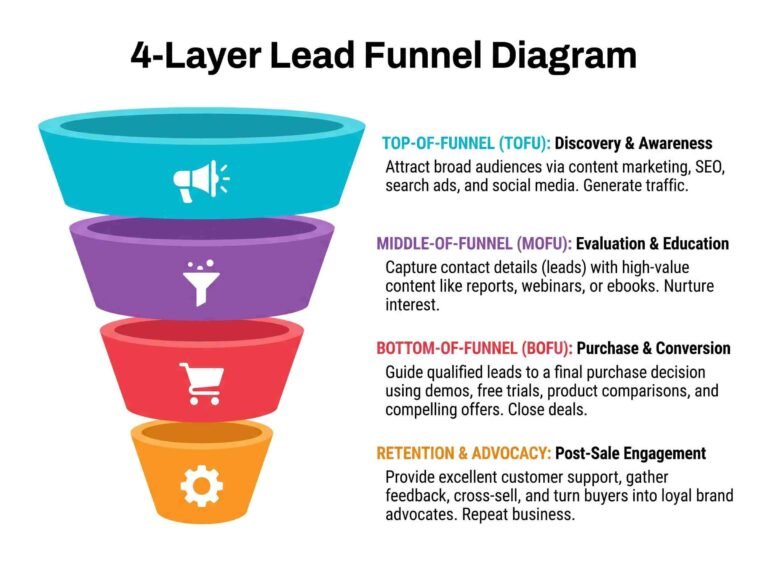
A lead funnel is the process a business uses to attract potential buyers, capture their interest, qualify their needs, and help suitable prospects move toward a purchase. It connects the first interaction with the next useful action, such as downloading a resource, requesting a quote, or booking a sales conversation.
Imagine a web design studio that receives 100 inquiries. Some people want a free template. Others need a website but cannot afford the service. A smaller group has a suitable project and wants to start soon. Sending the same sales message to everyone would ignore those differences.
A useful funnel gives each group an appropriate next step. It also shows the studio whether it needs more inquiries, better qualification, or stronger follow-up.
This guide explains the stages, then walks through a practical setup, a worked financial example, and a troubleshooting process. The examples and numbers are illustrative planning models, not client results or industry benchmarks.
On this page
- Lead funnel vs sales funnel vs sales pipeline
- The three lead funnel stages
- How to build a lead funnel
- A complete lead funnel example with numbers
- Lead funnel metrics and formulas
- How to find and fix funnel leaks
- Examples for different business models
- A lead funnel planning template
- Frequently asked questions
Lead funnel vs sales funnel vs sales pipeline
These terms overlap, and companies use them differently. Agreeing on what they mean inside your business matters more than choosing one supposedly universal definition.
| Term | Main question it answers | Practical use |
|---|---|---|
| Lead funnel | How do people become identifiable, qualified potential buyers? | Plan acquisition, capture, nurturing, and qualification. |
| Sales funnel | How many potential buyers move toward becoming customers? | Measure conversion through evaluation and purchase. |
| Sales pipeline | What needs to happen next in each active deal? | Assign discovery calls, proposals, negotiations, and follow-up tasks. |
A funnel gives you a conversion view across a group. A pipeline gives you an operational view of individual deals.
Some teams end their lead generation funnel when sales accepts a qualified lead. Others use “lead funnel” for the journey through purchase. For example, Salesforce emphasizes the marketing-to-sales handoff, while Zendesk describes a broader journey to becoming a customer.
In this guide, lead funnel setup covers acquisition through qualification, with downstream sales outcomes tracked to check whether those leads produce business.
The three lead funnel stages
The common three-stage model describes awareness, consideration, and decision. Use it to understand a buyer’s questions. Do not assume that everyone visits the same pages in the same order.
| Stage | Buyer’s question | Useful material | Possible next step |
|---|---|---|---|
| Top of funnel: awareness | What is causing my problem? | An explanation, diagnostic checklist, or practical tutorial | Explore the problem or request a relevant resource. |
| Middle of funnel: consideration | Which approach would work for me? | A comparison, demonstration, sample plan, or documented case study | Share requirements or evaluate a solution. |
| Bottom of funnel: decision | Is this provider the right choice? | Clear scope, pricing context, implementation details, and credible proof | Request a proposal, start a trial, or buy. |
Awareness
A business owner may search for reasons their website receives inquiries from unsuitable customers. An article explaining audience targeting and offer clarity helps them diagnose the issue before they choose a service provider.
The next step should match that question. A short website brief could be useful. A demand to schedule a long sales call may be premature.
Measure whether the content attracts relevant people and leads them toward meaningful actions. Traffic alone cannot tell you whether the audience could become customers.
Consideration
The same owner may now compare a website redesign with smaller landing-page changes. They need to understand cost, effort, trade-offs, and which problem each option solves.
Give them material that supports that decision. A comparison explaining when a full redesign is unnecessary can be more useful than a page claiming every business needs one.
An email address does not prove purchase intent. Someone might download a resource for research, education, or a future project. Qualification helps separate these situations.
Decision
When the owner is choosing a provider, unanswered practical questions become important: Who writes the copy? How are revisions handled? What access is needed? What would delay delivery?
Answer these questions before the buyer has to chase you. Make the next step clear, including what happens after a form submission or booking.
People can enter directly at this stage through a referral. They should not have to complete an educational email sequence before requesting a quote. INFUSE also notes that buyers can skip stages, return to earlier questions, and involve stakeholders with different levels of readiness.
How to build a lead funnel
Start with one audience, one specific problem, one offer, and one measurable route to a customer. Add complexity when you can identify the problem it will solve.
1. Define who should enter the funnel
Write a short description of a customer your business can serve well. Include the problem, relevant constraints, and reasons the buyer might act now.
For our illustrative web design studio:
- Audience: Small B2B service companies with an existing website.
- Problem: Their website does not explain their services clearly or attract suitable inquiries.
- Service: A defined website redesign project.
- Fit conditions: A genuine need for that service, a feasible budget, and access to the person coordinating the project.
- Exclusions: Job applicants, vendors pitching services, and requests outside the studio’s capabilities.
Use customer conversations, inquiry records, and lost-deal notes to refine this description. Record the phrases buyers use when describing the problem. Those phrases can make your landing page more specific.
2. Choose the offer and the next action
Choose an offer that helps someone move closer to solving the same problem your paid service addresses.
The studio might offer a website project brief that helps an owner identify missing pages, required integrations, and approval responsibilities. Completing it also prepares the buyer for a useful scoping conversation.
Match the action to readiness:
| Visitor’s situation | Suitable offer | Call to action |
|---|---|---|
| Learning about the problem | Website planning worksheet | Get the worksheet |
| Comparing possible approaches | Scope review or relevant project walkthrough | Review your requirements |
| Ready to discuss a project | A focused discovery call | Book a project call |
A lead magnet is optional. A buyer who already knows what they need may prefer a quote request. Keep that route available.
Before creating the offer, ask: “Would someone who could buy our service find this useful?” A popular giveaway that mostly attracts unrelated audiences can create work without creating opportunities.
3. Build a landing page that explains the exchange
A landing page should make the offer, audience, and next step understandable without requiring visitors to piece them together.
For the studio’s worksheet, include:
- A headline explaining the task: “Plan your B2B website redesign before requesting quotes.”
- A short description of the worksheet and who it is for.
- A preview showing what the reader will receive.
- A form requesting only information needed for delivery or routing.
- A clear button, such as “Send me the planning worksheet.”
- An explanation of what communication will follow.
- A confirmation message with access to the resource.
Use genuine proof where available. A screenshot of a real deliverable can explain your work without needing an exaggerated claim or an invented testimonial.
Keep form questions purposeful. An email address may be sufficient to deliver a resource. A project inquiry may justify questions about the website URL, requirements, and timing. Test whether each additional question improves the quality of the resulting conversations enough to justify the effort it adds.
Test the complete experience on a phone: open the page, complete the form, trigger an error, correct it, and retrieve the resource. A successful form submission is only useful if the next step works too.
4. Give every lead an owner and a status
Define how your team recognizes progress. A practical starting point is:
| Status | Example entry rule for the studio | Next responsibility |
|---|---|---|
| New lead | A valid project inquiry or relevant resource request is recorded. | Check the source, request, and fit information. |
| Marketing-qualified lead, or MQL | The business appears to fit the service and shows a relevant project need. | Ask sales to review the evidence. |
| Sales-accepted lead, or SAL | A named salesperson accepts responsibility for follow-up. | Make contact within the agreed response window. |
| Sales-qualified lead, or SQL | A conversation confirms a suitable need and willingness to explore a project. | Agree on a concrete next step. |
| Opportunity | A potential project has a defined scope and an active buying process. | Manage the proposal and decision. |
These are proposed operating rules, not mandatory industry thresholds. HubSpot’s lifecycle documentation distinguishes marketing qualification, sales qualification, opportunities, and customers, and allows custom stages.
Small teams can combine MQL and SAL if the distinction adds no value. Keep an owner, a next action, and a due date even when the workflow is simple.
Store the reason a lead was qualified. “Needs a redesign for an upcoming launch” gives the salesperson more context than a score with no explanation.
5. Separate customer fit from buying intent
Fit asks whether you can serve the buyer. Intent asks whether they are considering action.
A suitable company reading an educational guide may have good fit and low current intent. A person outside your service area requesting an immediate appointment may show strong intent but poor fit.
| Fit | Intent | Suggested response |
|---|---|---|
| Strong | Explicit project request | Prioritize a relevant human response. |
| Strong | Research activity only | Offer useful follow-up and a direct contact route. |
| Unclear | Explicit project request | Ask the minimum questions needed to establish fit. |
| Poor | Any | Explain the mismatch or redirect appropriately. |
Begin with rules you can explain. Numerical scoring becomes useful when lead volume makes manual prioritization difficult and you have outcomes to test the rules against.
Avoid letting repeated low-value actions add up to automatic sales readiness. Review whether your “qualified” leads actually reach useful sales conversations. If they do not, change the qualification rule rather than increasing the score assigned to the same behavior.
6. Write follow-up around the buyer’s task
For resource requests, begin by delivering what was promised. Then help the person use it. A possible sequence for the studio is below; the timing is a starting hypothesis to test, not a universal schedule.
| Timing | Purpose | Example subject |
|---|---|---|
| Immediately | Deliver the requested worksheet | Your website planning worksheet |
| About two days later | Help the reader complete one difficult section | Start with the page buyers ask about most |
| About five days later | Explain a decision or trade-off | Does your website need a redesign or a smaller fix? |
| About eight days later | Offer relevant assistance | Would a scope review help? |
The second message could say:
“When you complete your brief, start with the question customers ask before contacting you. Check whether your website answers it clearly. If it does not, add that page or section to your requirements. What question comes up most often in your sales conversations?”
For a direct project inquiry, respond to the request instead of enrolling the person in the same educational sequence:
“Thanks for outlining your website project. You mentioned that visitors struggle to understand your services. Which service do you most want the new site to generate inquiries for? That will help us make the first conversation useful.”
Pause automated sales messages when a person replies, books a meeting, becomes a customer, or opts out. Keep delivery of a requested resource distinct from any ongoing marketing subscription, and make communication expectations clear.
7. Define the sales handoff
Write down who receives a qualified inquiry, when they should respond, and what happens if they cannot take it.
For a small team, a starting operating target might be a human response within one business hour during staffed hours. Choose a target the team can meet and tell buyers what to expect outside those hours. An automated acknowledgment should not be counted as the human response.
Every handoff should include:
- The original request and relevant source information.
- The reason the lead appears suitable.
- Any timing, scope, or budget information volunteered by the buyer.
- The owner and response deadline.
- The next step offered to the buyer.
If sales declines the lead, record why: outside scope, insufficient information, wrong timing, or no genuine project. Those reasons help marketing improve the offer and targeting.
8. Connect tracking before adding more traffic
Record the meaningful events in the process: a valid inquiry, a qualified lead, a completed conversation, an opportunity, and a customer. Keep a stable record identifier so repeated submissions do not become multiple new leads.
In WordPress, the basic setup needs a working page and form, a place to store leads, a reliable notification or delivery method, and a way to record outcomes. You can begin with a carefully managed spreadsheet or CRM, then add automation when ownership and stages are clear.
If you use Google Analytics 4, Google documents recommended events including generate_lead, qualify_lead, and close_convert_lead. Configure them to reflect actual outcomes in your process; a button click alone does not prove that a lead was created. Google Analytics event reference
Use the CRM or lead register to verify actual records and sales outcomes. Website analytics may not capture every person or interaction. Keep sensitive contact details in the appropriate lead system rather than placing them in analytics event names or page URLs.
A complete lead funnel example with numbers
Consider one acquisition cohort for the hypothetical studio: people who first enter during the same month and are followed for 90 days. Assume each lead represents one potential buying business and each successful business buys one project.
| Step | Number reaching the step | Conversion from the previous step |
|---|---|---|
| Landing-page visitors | 2,000 | Starting audience |
| Valid new leads | 100 | 5% |
| Marketing-qualified leads | 40 | 40% |
| Sales-qualified leads | 20 | 50% |
| Opportunities | 10 | 50% |
| Customers | 4 | 40% |
These are invented numbers for understanding the calculation. They are not recommended targets.
Assume campaign spending is $3,000 and each completed sale is a $5,000 project:
- Campaign cost per lead: $3,000 ÷ 100 = $30.
- Campaign cost per qualified lead: $3,000 ÷ 40 MQLs = $75.
- Campaign spending per customer: $3,000 ÷ 4 = $750.
- Booked project value: 4 × $5,000 = $20,000.
The $750 figure includes campaign spending only. If the fully allocated acquisition cost for this cohort is $6,000 after including relevant sales effort, marketing labor, and tools, customer acquisition cost is $6,000 ÷ 4 = $1,500.
Booked project value is not profit or cash collected. Delivery costs, payment timing, and the acquisition costs still matter.
How to use the numbers to choose an improvement
Suppose inquiry reviews show that suitable leads often receive a late response. Test whether fixing the handoff improves the MQL-to-SQL rate.
If that rate rose from 50% to 70%, the same 40 MQLs would produce 28 SQLs. Holding the later rates unchanged gives 28 × 50% × 40% = 5.6 expected customers.
That is a scenario estimate across repeated cohorts, not a prediction that one cohort will produce a fractional customer or a guaranteed uplift. The test must establish whether the response change actually helps.
Work backward from a customer goal
Using the original example rates, a target of six customers would require:
- 6 ÷ 40% = 15 opportunities.
- 15 ÷ 50% = 30 SQLs.
- 30 ÷ 50% = 60 MQLs.
- 60 ÷ 40% = 150 leads.
- 150 ÷ 5% = 3,000 landing-page visitors.
This calculation is useful for capacity planning. Replace the assumptions with your own mature cohort results before using it to set budgets.
Lead funnel metrics and formulas
Choose metrics that answer a decision. Define the denominator, counting unit, cost scope, and observation window before comparing performance.
| Metric | Formula or definition | Decision it supports |
|---|---|---|
| Visitor-to-lead rate | Valid new leads ÷ relevant visitors × 100 | Does the page and offer attract a response? |
| Lead qualification rate | Leads meeting the chosen qualification rule ÷ valid new leads × 100 | Is the funnel attracting suitable potential buyers? |
| MQL-to-SQL rate | SQLs from an MQL cohort ÷ MQLs in that cohort × 100 | Is qualification and handoff producing sales conversations? |
| Opportunity win rate | Won opportunities ÷ all opportunities in a sufficiently mature cohort × 100 | How often do potential deals become customers? |
| Cost per qualified lead | Defined acquisition spending ÷ qualified leads generated | What does a suitable lead cost under this definition? |
| Customer acquisition cost | Relevant sales and marketing acquisition costs ÷ new customers | How expensive is acquiring a customer? |
| Time to first response | Time between the inquiry and first meaningful human response | Are buyers waiting longer than promised? |
| Time in stage | Time since entry for open records; entry-to-exit time for completed records | Where are leads getting stuck? |
If you report win rate only across closed deals, label it “closed-deal win rate” and calculate wins ÷ (wins + losses). It answers a different question from wins across the full opportunity cohort, especially while many deals remain open.
Avoid misleading comparisons
Compare the same acquisition cohort. Dividing this month’s customers by this month’s leads can mislead you when those customers first inquired months earlier. State the follow-up period and the number still open.
Keep counting units consistent. Three contacts from one company may represent one buying opportunity. Do not treat them as three separate potential contracts. Website visitor counts are also measurement estimates, not a perfect count of identifiable people.
Segment before changing everything. Compare lead source, offer, device, or service requested. A total average can hide one poorly matched campaign.
Preserve attribution context. Record the first known source, the inquiry source, and any source the buyer reports. These can differ. Attribution describes observed touchpoints; it does not prove that one channel caused the purchase.
How to find and fix funnel leaks
Start by confirming that the apparent drop-off is real. Broken forms, duplicate records, and missing sales updates can make a working funnel look unsuccessful.
Then use the pattern to choose a specific investigation:
| Symptom | What to check first | Focused change to test |
|---|---|---|
| Relevant traffic, few inquiries | Form errors, mobile usability, offer clarity, unexpected requirements | Repair failures; then test a clearer offer or simpler form. |
| Many inquiries, few suitable leads | Search terms, referral sources, giveaway appeal, unclear service scope | Clarify who the service is for and add one useful fit question. |
| Suitable leads, few conversations | Assignment, response delays, message relevance, deliverability | Give each inquiry an owner and respond to its actual request. |
| Bookings, few attended meetings | Time-zone confusion, unclear meeting purpose, difficult rescheduling | Confirm the agenda, time zone, and rescheduling route. |
| Good conversations, few opportunities | Unclear need, timing, service mismatch, absent decision participants | Improve discovery and agree on a specific next step. |
| Proposals, few wins | Unresolved objections, unclear scope, competing priorities | Clarify the proposal and review actual lost-deal feedback. |
| Cheap leads, expensive customers | Low qualification or poor downstream conversion | Compare customer economics by source before increasing spend. |
Treat these as hypotheses, not automatic diagnoses. Review actual records and talk to the people handling the work.
When testing a change, define the primary outcome first. If you simplify a form, measure qualified inquiries as well as completed forms. Otherwise, a higher submission rate could disguise a fall in lead quality.
Avoid declaring a winner from a handful of conversions. Record the sample size, allow enough time for the outcome being measured, and consider whether traffic mix or seasonality changed during the test.
Examples for different business models
The right funnel depends on how the buyer makes a decision.
| Business | Possible entry point | Useful next step | Evidence of progress |
|---|---|---|---|
| B2B consulting | A guide addressing a specific operational problem | A diagnostic discussion | The buyer confirms a suitable problem and agrees to explore scope. |
| Software | A use-case page or product tutorial | A trial or relevant demo | The user completes an action that demonstrates the product’s value. |
| Local service | A service page answering a location-specific need | A quote or appointment request | Service area and job requirements are confirmed. |
| Ecommerce with a considered purchase | A buying guide or product comparison | A consultation, product shortlist, or purchase | The shopper selects a suitable product or asks a concrete purchase question. |
For a software trial, define activation around the job the product performs. In a scheduling tool, creating and using a booking page may be more informative than simply logging in.
For a local service, do not force someone with an urgent request to download an ebook first. Make the direct contact option easy to find.
For B2B purchases, several people may need different information. A user may care about workflow, a manager about implementation, and a finance reviewer about cost. Connect those conversations to the same account or opportunity where appropriate.
A lead funnel planning template
Copy this into a working document before building pages or buying software:
| Planning question | Your decision |
|---|---|
| Who can we serve well? | Define the audience and important exclusions. |
| What problem brings them here? | Use the buyer’s wording. |
| What do we sell? | State the paid offer and its boundaries. |
| What is the next useful action? | Choose a resource request, quote, trial, or conversation. |
| What information do we need? | Keep only fields needed for delivery, qualification, or routing. |
| What makes a lead qualified? | Write observable fit and intent rules. |
| Who owns the response? | Name an owner and backup. |
| When should they respond? | Set a realistic target and out-of-hours expectation. |
| What happens to unsuitable or not-yet-ready leads? | Define decline, nurture, and later follow-up options. |
| How will we measure success? | Specify cohort, stage conversions, costs, and customer outcomes. |
| What will we test first? | Choose one suspected bottleneck and one outcome. |
Before launch, send a test inquiry through every route. Confirm the record is created once, the correct person receives it, the resource or confirmation arrives, and the next action is clear.
After launch, review the first set of inquiries individually. Their questions and reasons for not progressing will tell you what needs attention before you scale traffic.
Frequently asked questions
What is the difference between a lead and a prospect?
Businesses use these labels differently. A practical convention is to use “lead” for an identified potential buyer and “prospect” for someone whose relevance has been assessed. Record the actual qualification evidence so the label does not replace useful information.
What is a lead magnet funnel?
A lead magnet funnel starts with a useful resource offered in exchange for contact information, followed by relevant communication and a path toward a paid offer. It is one way to generate leads; direct quote requests, referrals, and product trials are other routes.
What is a good lead funnel conversion rate?
There is no single rate that describes every funnel. Visitor-to-lead, lead-to-qualified-lead, and opportunity-to-customer rates measure different transitions. Compare equivalent audiences, offers, definitions, and time windows, then check whether the resulting customers justify the acquisition cost.
How many funnel stages do I need?
Use enough stages to identify meaningful changes in responsibility or buyer readiness. A solo consultant may need inquiry, qualified conversation, proposal, and customer. A larger team may need separate marketing qualification, sales acceptance, and sales qualification stages.
Can I build a lead funnel without paid advertising?
Yes. Relevant search traffic, referrals, partnerships, events, and an existing audience can all bring people into a funnel. Each route still requires effort and a clear offer. Track whether it produces suitable leads and customers before deciding how much to invest.
What should happen to leads that are not ready to buy?
Distinguish bad timing from poor fit. For a suitable buyer with a later project, agree on a useful follow-up date or relevant communication. Close out requests you cannot serve, and respect decisions to stop contact. Keep the reason so those records do not repeatedly return to active sales.
What software do I need for a WordPress lead funnel?
At minimum, you need a page that explains the offer, a reliable way to submit an inquiry, a lead register, and a follow-up process. Add email automation, booking, CRM integrations, and analytics when they address a defined need. Test the connections between tools as carefully as the tools themselves.
Start with the planning template, build one complete route, and follow a test lead from submission to outcome. Then improve the step that prevents suitable buyers from moving forward.